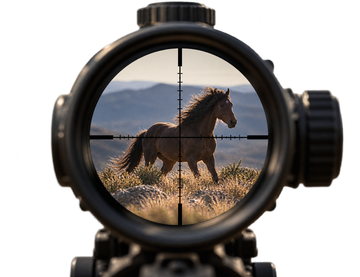
The horse industry has had several thousand years to develop a reliable transport product. It has delivered a vehicle that runs on breakfast, leaks onto the road and can be disabled by a jacket hanging on a fence.
We are nevertheless repeatedly assured that horses are intelligent.
They know the way home. They remember people. They can sense your fear, a feature the Office considers substantially less useful than indicators.
Following renewed industry claims that horses possess “excellent road sense”, the Research Unit has completed an assessment of the animal’s so-called Full Self-Trotting system. Findings include ignored signs, unpredictable overtaking, unauthorised reversing and an emergency manoeuvre triggered by a discarded Bunnings receipt.
The receipt was for a hose fitting. There was nothing in it to justify the response.
The industry has described the results as encouraging.
The Office has requested that it stop.
The horse detected the hazard. It then became the hazard.
Testing took place along a suburban route incorporating an intersection, a shared path and a school zone. The horse was accompanied by an experienced rider, whom industry documentation identifies as a safety measure and hospital documentation identifies by name.
Early results appeared promising. The subject noticed a cyclist approaching from behind, turning its ears towards the sound well before the bicycle came alongside.
It then moved into the cyclist’s path.
For the first time in the assessment, the horse enjoyed a brief surge of departmental goodwill. Meredith Vale entered “possible public service” in the margin. Transport Compliance asked her to assess the manoeuvre rather than the person it had inconvenienced. She requested a wider margin.
The cyclist remained upright and unharmed, although his personal best did not survive. He subsequently delivered a roadside statement of sufficient length to establish that the horse had interrupted somebody who was otherwise going to spend the entire morning talking about cycling.
“We are obliged to acknowledge the animal’s occasional usefulness,” Vale said. “It has identified a competing nuisance and made him stop explaining his equipment.” A proposed commendation was deferred when the horse attempted to eat it.
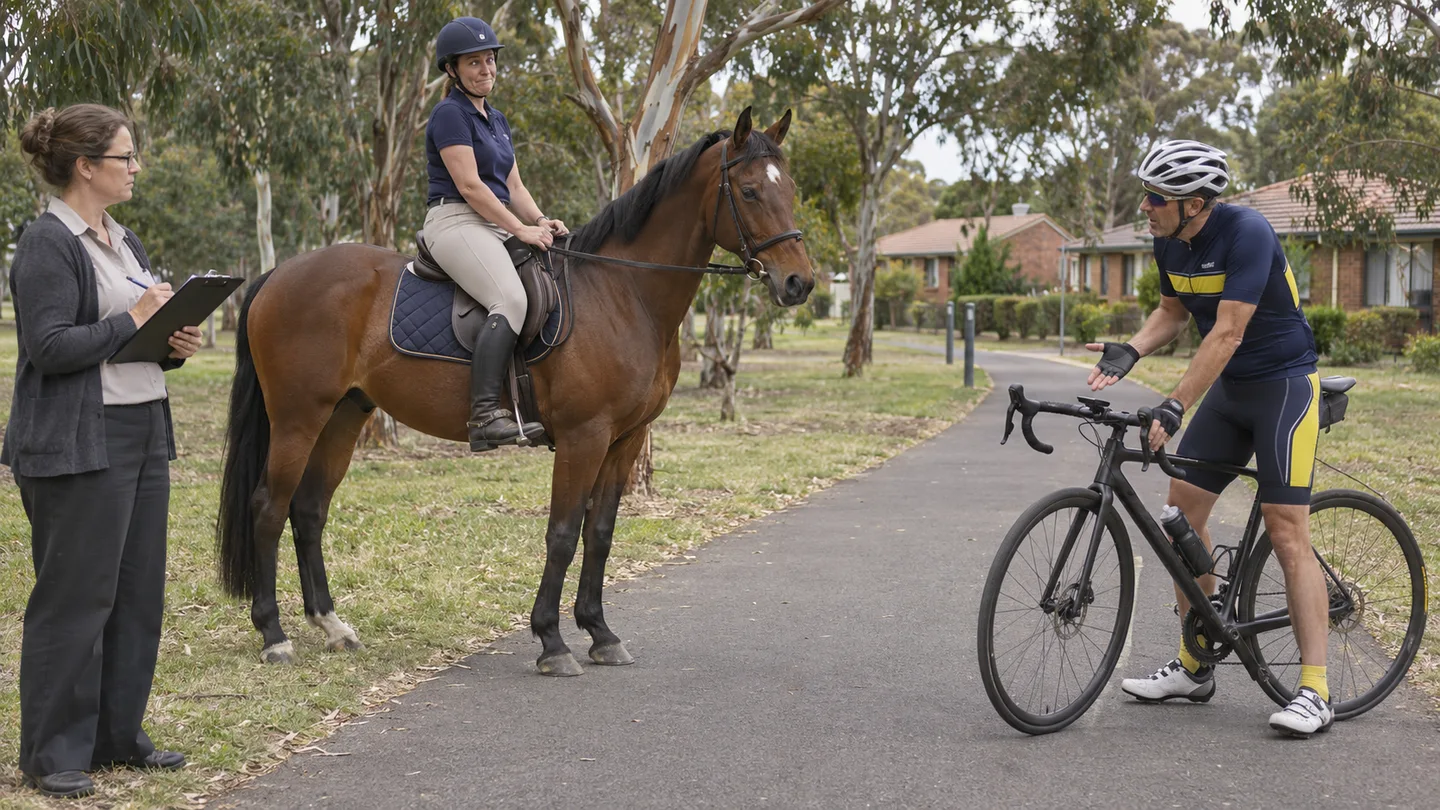
This distinction matters. The horse had successfully detected another road user. What it did with that information was apparently a matter for the horse.
Later, the subject approached a school-zone sign without any observable recognition of its contents. It did, however, recognise that the grass around the post was slightly longer than the surrounding grass and attempted an immediate left turn across the footpath.
Researchers concluded that the sign had influenced the journey, although Transport Compliance declined to record this as a pass.
At a pedestrian crossing, the horse stopped and refused to proceed. Its handler initially described this as evidence of caution around pedestrians. There were no pedestrians. The horse objected to the stripes.
The Office is reluctant to award road-safety points to a system that obeys a crossing because it suspects the crossing is a predator.
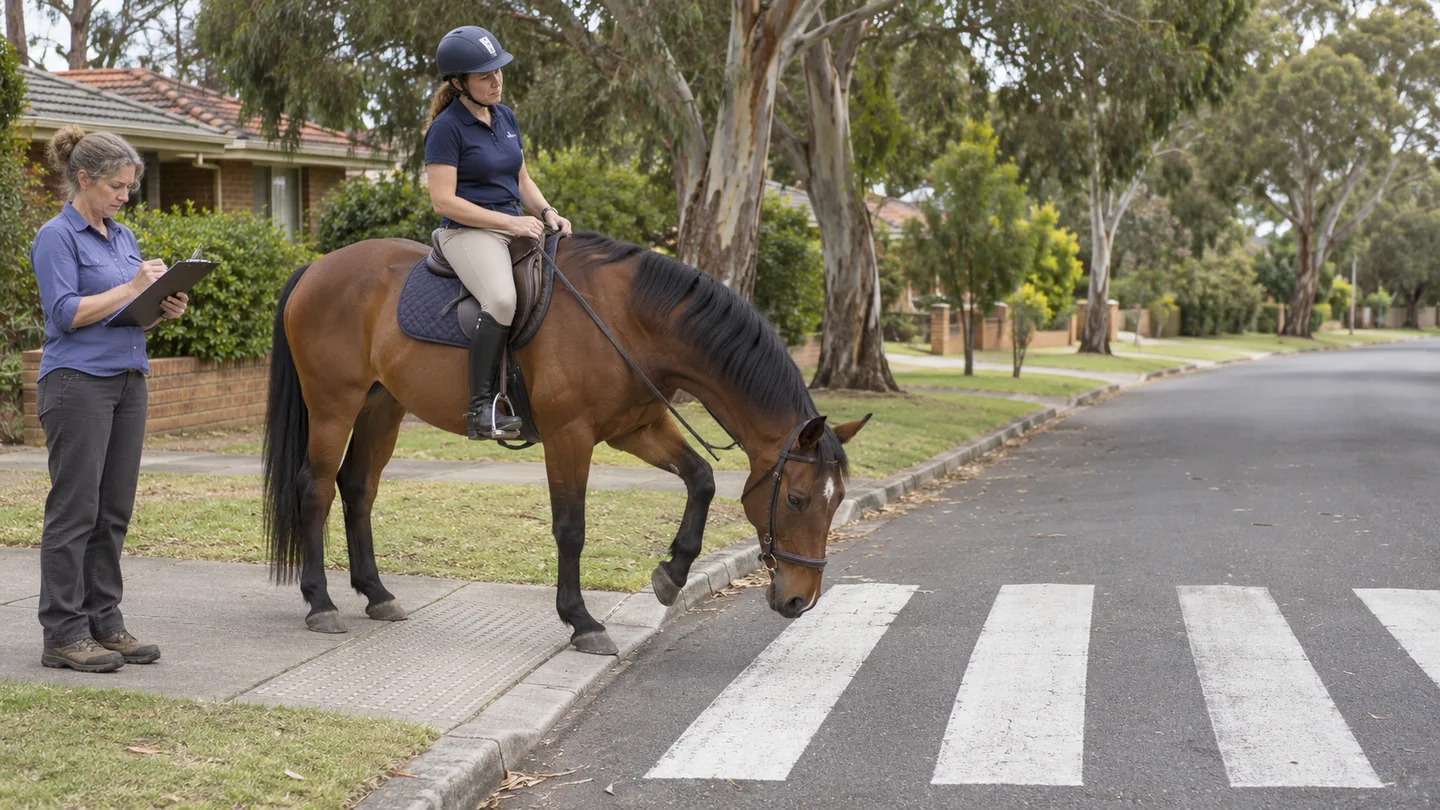
“There’s a person on top” remains the entire safety case
Industry representatives emphasised that Full Self-Trotting is a supervised system. The rider remains responsible for navigation, speed, hazard management and any sudden decision by the vehicle to leave the road vertically.
The horse, meanwhile, retains final approval.
During testing, researchers observed that asking the animal to stop required the rider to apply pressure through the reins. Asking it to move required pressure through the legs. In moments of surprise, the rider could accidentally do both.
The resulting control interface has been praised for being intuitive by people who have spent twenty years learning it.
An accompanying handler explained that the horse could also detect tension in the rider and become nervous in response. Researchers asked whether a rider noticing an approaching danger might therefore make the vehicle less manageable at the precise moment control was most necessary.
The handler said horses were very sensitive.
This has been entered in the report under “Yes”.
Defenders of the system argue that a good rider anticipates what might frighten a horse. The Office understands this to mean that the safety operator must continuously assess the road for actual hazards while also maintaining a second, much larger register of things the horse might find spiritually unacceptable.
During the assessment, that register included a pram, a drain cover, a person carrying flowers and the shadow of the horse.
The shadow remained attached throughout the incident. No recall mechanism was available.
A wheelie bin performed better
To establish whether the testing conditions were unreasonable, researchers placed a council wheelie bin beside the route.
The bin remained within its designated area, did not obstruct a cyclist and displayed no interest in eating a member of the assessment team. It was fitted with two wheels, a visible identifier and a lid that closed.
The horse had none of these features.
At the end of the observation period, the bin was collected by a truck according to a published schedule. Loading took approximately seven seconds and required no soothing, blindfolding or discussion of a difficult experience the bin had had in a previous truck.
Loading the horse took forty-three minutes, two people and the progressive transfer of a bag of carrots.
During this process, its owner explained that the animal was too intelligent to be easily persuaded.
Researchers noted that the bin had already gone.
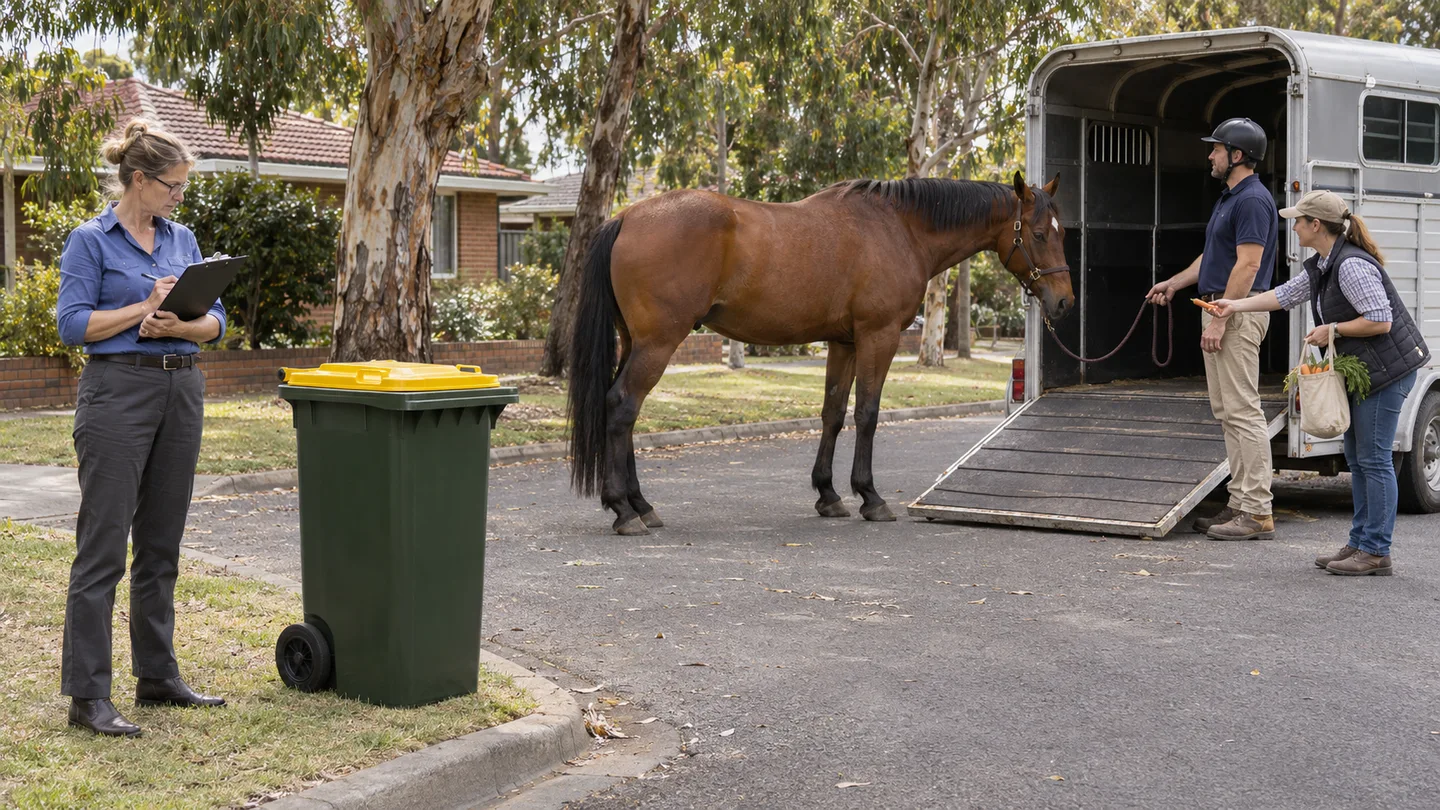
Imagine being so bad at transport that you lose to a wheelie bin. Then imagine doing it in Australia, where getting anything collected by the council is normally considered a major infrastructure achievement.
The industry challenged the comparison on the grounds that the bin could not move independently.
The Office agreed. This had been one of its strongest results.
A second objection noted that bins sometimes blow over in strong winds. The Research Unit accepted this limitation and amended its findings: the bin could become unpredictable in severe weather; the horse could become unpredictable because someone took off a jumper.
A class dispute conducted in expensive trousers
The incident prompted a supplementary comparison between horse transport and its principal rival in the field of making a recreational purchase everyone else’s responsibility: the MAMIL, or middle-aged man in Lycra.
The horse owner arrived in a vehicle capable of towing a small regional hospital and explained that riding kept her connected to a simpler way of life. The cyclist arrived on a carbon-fibre bicycle worth more than the Research Unit’s pool car and explained that cycling was accessible to everyone. Both subsequently asked whether the café had somewhere more appropriate to put their equipment.
The Office found considerable overlap. Both participants had bought a saddle and developed an entire social hierarchy around it. Both wore specialist trousers to travel to coffee. Both described their hobby as a community, by which they meant a group of people who could identify an inferior purchase from forty metres away.
The differences were largely financial. Horse ownership announces that the family has land. The senior MAMIL announces that he works in wealth management, usually without being asked. His bicycle has been stripped of every unnecessary gram, a discipline that has not extended to his account of the purchase.
Public submissions referred to the cycling contingent as “road toads”. The Research Unit rejected this terminology because actual toads do not occupy six café tables while explaining marginal gains. The preferred designation is “mobile executive grievance”.
On safety awareness, the assessment found that the horse could not read a road sign. The cyclist could read it, quote the relevant provision and explain its application to every person present except himself. He maintained that the section beside the playground was technically a training segment. The playground had not been consulted.
The horse’s attention wandered towards grass. The cyclist’s wandered towards the small screen informing him that he was eleven seconds behind a dentist from Mosman. Both were therefore navigating a public space while taking instructions from something the pedestrian could neither see nor negotiate with.
The MAMIL also possessed a bell, giving him a clear technical advantage over the horse. He demonstrated it repeatedly while approaching a family from behind, then expressed disappointment that the children had failed to disperse like a professionally drilled infantry unit. The horse, to its credit, had generally waited for pedestrians during the main assessment. It had not demanded that they respect its split times.
Researchers concluded that the two systems presented different supervision problems. The horse needed a person capable of controlling a horse. The MAMIL needed a person capable of telling a regional sales director that he was not in the Tour de France. No suitably qualified applicant was available for the second role.
The wheelie bin was asked whether these findings altered its position. It continued to contain its rubbish internally.
Everyone else has been appointed to the safety team
The investigation also examined the public’s role in making horse transport possible.
Motorists are asked to slow down. Cyclists are asked to announce themselves, but gently. Pedestrians are asked to give the animal room. Dog owners are asked to keep their dogs under control, an expectation the horse apparently regards as species-specific.
Nobody is supposed to sound a horn, accelerate suddenly or make an unexpected noise.
Australia has consequently admitted a vehicle to its roads on the understanding that the surrounding population will try not to startle it into an incident.
This arrangement is especially ambitious in a country where a standard suburban journey may involve a leaf blower, three cockatoos dismantling a verandah and a modified Commodore announcing its departure from the next postcode.
One industry submission explained that horses are prey animals and therefore naturally inclined to flee perceived danger.
The Office accepts the explanation. It remains unclear why this was submitted as a transport qualification.
A bus operator could not explain a service mounting the footpath by saying the bus had evolved to fear wolves.
The good behaviour was real. So was the rest of it.
The report records several positive observations. The horse waited patiently at a gate, gave a pedestrian ample space and stood quietly while a child patted its neck.
These are welcome behaviours. They do not cancel out the incident involving the umbrella.
The umbrella was opened approximately twelve metres from the subject. The horse responded by attempting to occupy a different twelve metres, some of which already contained a café.
Its owner subsequently described it as “usually bombproof”.
Legal Affairs has requested that this term be withdrawn until the industry can demonstrate resistance to light rain accessories.
There is a persistent tendency, the report notes, to treat a horse’s pleasant moments as evidence of competence and its dangerous moments as evidence that somebody nearby failed to understand horses.
When the animal behaves, it is intelligent. When it does not, the cyclist approached incorrectly, the pedestrian moved too quickly or the rider should have known better.
It is an impressive warranty. Almost nothing is covered.
The bin has been invited to advise the department
The Office has recommended suspending the expression “excellent road sense” until it can be demonstrated in the presence of a road.
Further requirements include a reliable stopping procedure, a documented response to plastic bags and an explanation of why a transport product marketed for its independence requires a second transport product to take it anywhere it does not already wish to go.
The industry says these requirements fail to account for the special bond between horse and rider.
The Office has a special bond with its photocopier. Procurement still expects it to handle A4.
Manufacturers were invited to submit a corrective action plan. They supplied a photograph of a foal and advised that the next generation would be better.
The Research Unit has declined to wait another four years for a software update that needs to learn about buckets.
Meanwhile, the wheelie bin has accepted an advisory position on the transport review panel. Its appointment was challenged after an industry representative alleged that it was full of rubbish.
The allegation was upheld.
It remains the best-qualified member of the panel.